Recognition and Consistency
World Teachers’ Day, celebrated on 5 October, is an opportunity to recognise teachers and the important role they play in education. For us at One, Two…Tree!, it is also an opportunity to reflect on something that sits behind every successful education program: consistency.
In international development and volunteering, there is often a lot of attention on what happens during a volunteer placement. A new volunteer arrives, meets their students, starts teaching and becomes part of the community.
But what happens when they leave? For students and teachers, the answer cannot be to start again from the beginning.
The value of an education program is not only in what happens during each individual placement. It is also in the relationships, routines and trust that are built over time.
That is why we believe that showing up consistently matters.
Education is built on relationships
Learning does not happen in isolation.
Students learn through relationships with teachers, classmates and the wider community. Teachers get to know their students over time. They understand their progress, their personalities and the challenges that can affect their learning. That takes time.
The same is true for organisations working alongside schools and communities.
An NGO cannot expect to understand a community simply because it has spent a few weeks working there. Trust develops gradually – through listening, keeping commitments, learning from experience and continuing to show up.
This is particularly important when an organisation works with international or local volunteers.
A volunteer might spend six weeks, three months or longer in a community or with a project. Their contribution can be valuable, but their placement is only one chapter in a much longer story.
The responsibility for continuity belongs to the organisation, not to the individual volunteer.
The volunteer changes, the program should not have to
Volunteering naturally involves change. Volunteers come from different countries, regions and backgrounds. They have different skills, personalities, teaching styles and availability. Some stay for several months; others are with us for a shorter period.
That variety can be a strength. But students should not have to experience a completely different program every time a volunteer changes.
This is where structure and consistency become important.
A well-established program can provide continuity through lesson planning, shared resources, communication between volunteers, local coordination and strong relationships with schools and teachers.
The individual may change.
The commitment does not.
Why local teachers are so important to continuity
This is one of the reasons local partners and teachers are such an important part of our work.
Local teachers provide a continuity that international volunteers cannot.
They know the students. They understand the school environment. They are there throughout the school year and continue supporting their learners long after an individual volunteer has returned home.
For any volunteer, working alongside teachers also provides an important connection to the community.
Teachers can help volunteers understand the context in which they are teaching, provide feedback and help ensure that activities are appropriate and useful for their students.
This is not about asking local teachers to manage or supervise volunteers.
It is about recognising that education programs are stronger when the people who are permanently connected to the community are part of the relationship.
Showing up is about more than being physically present
When we talk about consistency, we do not simply mean being in the same place every year. Sustained NGO presence is about maintaining relationships and commitments over time.
It means returning to the same communities and continuing to listen.
It means remembering what has been learned from previous years.
It means developing program gradually rather than constantly starting from scratch.
And it means being honest when something is not working and being willing to adapt.
Long-term community engagement is rarely dramatic. There may not be a single moment when everything changes.
Instead, progress can look like a student becoming more confident speaking English. A teacher becoming familiar with a program. A school knowing who to contact when a question arises. A volunteer building on the work of someone who came before them.
Small things accumulate.
Trust takes time
Trust is one of the most important outcomes of consistency, but it is also one of the easiest things for an organisation to overlook.
A community needs to know that an organisation will do what it says it will do. Schools need to know that a program will continue. Teachers need to know that they can communicate with the organisation. Students need to feel comfortable with the people teaching them. Volunteers need to know that they are joining something with established relationships and support around them.
None of this happens overnight. It develops through repeated interactions and shared experiences. Consistency creates familiarity. Familiarity creates trust. And trust creates the foundation for meaningful collaboration.
What consistency looks like at One, Two…Tree!
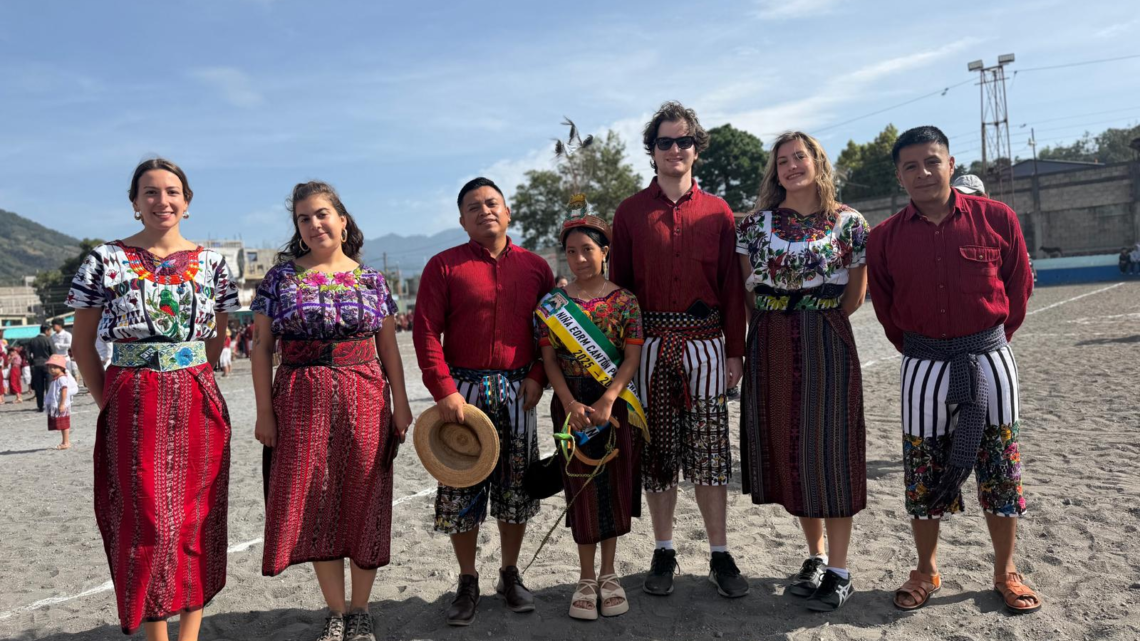
Our work in Santiago Atitlán has developed over many years. That history matters.
We are not visiting a community for the first time every time a new volunteer arrives. We have existing relationships with schools, teachers, community organisations and local coordinators.
Our program can therefore build on what has happened before.
A volunteer arriving today benefits from the work and relationships developed by volunteers who came before them. They can use existing resources, learn from previous experiences and contribute ideas of their own.
And when they leave, the program continues. That continuity is particularly important for students.
Rather than their English education being dependent on whether one particular volunteer happens to be available, we can build a program that exists beyond any individual.
That is what turns volunteering from a series of individual placements into a longer-term education program.
Consistency does not mean never changing
Of course, consistency should not mean doing exactly the same thing forever.
Communities change. Students change. Schools change. Needs change.
A responsible NGO needs to be able to respond.
For us, long-term presence means having enough knowledge and trust to recognise those changes and adapt appropriately.
A program can introduce new activities, change its resources, respond to feedback or develop new partnerships while still maintaining its core commitment to the community.
In fact, consistency makes meaningful change easier. When relationships already exist, organisations can listen to feedback, understand what is happening and make decisions based on experience rather than assumptions.
The importance of showing up
International development can sometimes focus on measurable outputs: how many students attended, how many classes were delivered, how many volunteers participated.
These numbers are useful. But they do not tell the whole story.
There is also value in being the organisation that keeps answering the email. The organisation that returns next year. The organisation that remembers the conversation from two years ago. The organisation that knows the teachers, listens to the community and understands that progress takes time.
That is long-term community engagement.
It is not necessarily the most visible part of NGO work, but it can be one of the most important.
This World Teachers’ Day, we are celebrating consistency too
Teachers remind us that meaningful education is built over time.
A teacher does not measure their impact by one lesson. They see their students develop across months and years.
We believe organisations working in education should take a similar approach.
Volunteers bring energy, skills and new perspectives. They can make a genuine contribution to students’ learning and become an important part of an education program. But the value of that contribution is greater when it forms part of something continuous.
The volunteer may change. The teacher remains. The students remain. The community remains. And the organisation has a responsibility to keep showing up.
For us, that is what a sustained NGO presence should mean: not simply being physically present, but building relationships strong enough to continue, learn and grow over time.
This World Teachers’ Day, we are grateful to the teachers who show up for their students every day, and to the schools, community partners, volunteers and local coordinators who continue to show up alongside them.
Because sometimes the most meaningful thing an organisation can offer a community is not a quick solution.
It is the commitment to keep showing up.