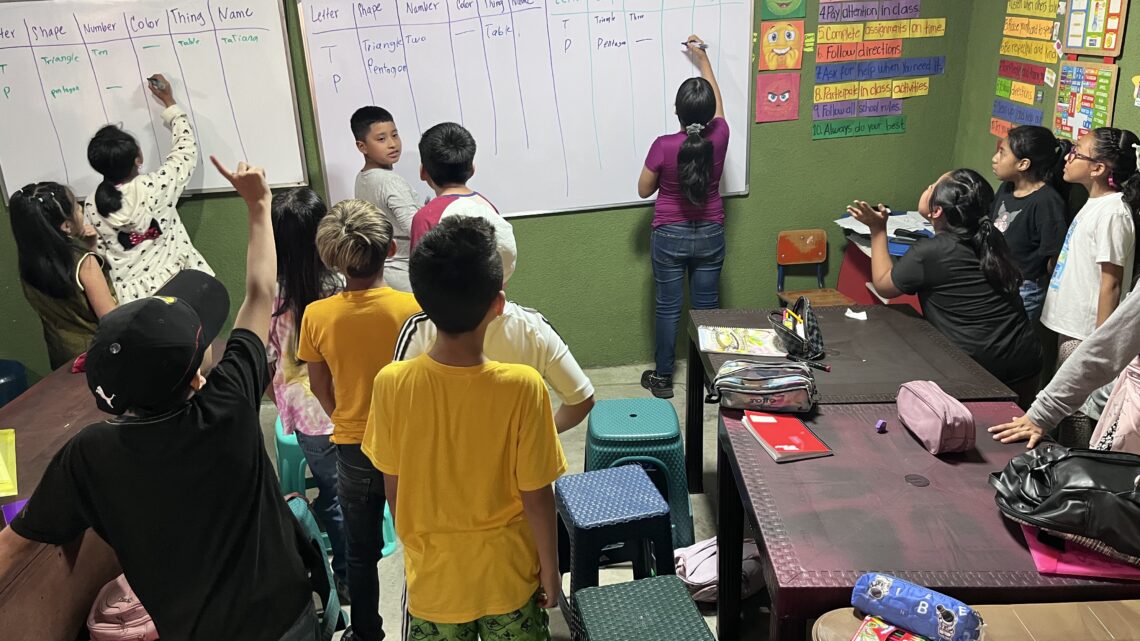
How to teach English to kids – 11 useful tips
Being fluent in English is one thing, but being able to teach it is a completely different game. If you learned English as a second language, it will be easier for you to empathise with the process and understand your students’ struggles, yet it is important to have some strategies in place to avoid falling down the route of copying and filling out grammar worksheets all day long.
If you have never taught English before, do not worry; we have some tips for you so you can start on the right foot teaching English to kids.
Note: Even though it is best to have some variety in your classes, you don’t have to constantly come up with new activities to teach English as it can be pretty exhausting as a teacher! If you find your students respond well and enjoy a set of games, go ahead and continue to use them, adjusting the difficulty level accordingly.
1. English only
Our first and most important tip is to speak English only throughout the class.
It is normal that children won’t understand at first, but don’t try to translate. Instead, use all the resources available to you to make yourself understood (mimicking, drawing, using flashcards…). Make it a game!
This will expose children to English and their brain will start assimilating words as concepts, as opposed to the exact translation. We are looking to develop their flexibility to understand the context of a sentence even when they only understand one or two words. Constantly translating brings rigidity to the brain and slows down the process of learning a language, stopping them from communicating when they don’t have the exact word they are looking for.
2. Encourage speaking – Eliminate pressure
From day one, encourage children to speak without the pressure of having to create perfect sentences. Create situations of need where children need to speak English, for example asking to go to the toilet, to come in when they are late, and keeping crayons and other resources with you so children need to ask to use them.
Don’t be afraid to write down the pronunciation of the word or sentence so they learn it right from the beginning (for example, the word ‘please’ would be pronounced as ‘pliis’ for a Spanish speaker). Always positively reinforce their speaking attempts; give a thumbs up, smile, and reply back accordingly. If possible, use token economy to encourage speaking, for example, during a class, a point or token is given for every correct intervention. The student that ends up with the highest number of tokens, wins.
3. Creating a routine
Since the whole lesson should be in English, creating routines helps children understand what comes next and facilitates the process of explaining activities and methodology. Start with greetings, perhaps write the date on the board depending on the age, and a quick review of what you learned in the previous class. Then, introduce the new topic, do an activity together followed by individual activity, summarise learnings and say goodbye.
4. Keep it fun and simple!
Scaffold concepts, from easiest to hardest. Break down the target of the lesson into simple concepts and use lots of repetition so that the students’ brain assimilates new words in different contexts.
Make sure activities are linked and increase in difficulty while using the same vocabulary, so the concepts within the lessons are assimilated. Don’t try to cover more than one target per lesson (i.e. vocabulary, grammar, speaking, etc) to avoid confusion.
5. Use visual support
Make use of flashcards and posters hung on the walls for students to visualise and repeat the new words targeted. To teach the colours, we have a poster hung on the wall so children need to go to the poster, read the colour they want, and come to where we keep the crayons to ask for that specific colour. Normally, the children love coming back and forth to the poster since they take it as a game.
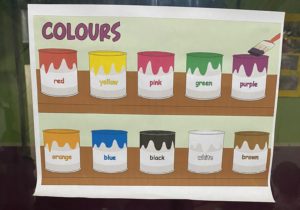

Visual resources at our Learning Centre
6. Incorporate your students’ interests into lessons
Make it culturally relevant and age-appropriate. In our Guatemalan project, we are currently looking to teach all content with a Guatemalan perspective, which includes local animals, fruits and vegetables, or family flashcards representing Tz’utujil people with their traditional clothing.
Also, keep in mind their age and what is exciting for them at that age. For example, animals and fruits are a favourite amongst 8-year-olds, whereas describing famous people is engaging for teenagers (you will just need to do a bit of research on who is ‘cool’ for your audience!).
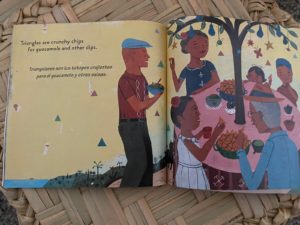
“Tortillas are round”, a book used to teach the shapes[/caption]
7. Teaching English to kids? Use technology too!
As part of the routine, you can introduce vocabulary using videos in an engaging way. If Whatsapp is available, make sure you share the resources used in class afterward so they can review them at home. Depending on the size of the class, there is a myriad of digital activities to make learning fun.
8. Using music to learn English
Music is magic for children. It captivates their attention and makes them remember complex sentences. Use movement while you sing so they can identify the meaning of each sentence.
We usually sing a welcome song with the younger students (up to 10 years old) and sing a song related to the topic seen in class at the end of the lesson as a prize for good behaviour and a fun way to finish the class. Play with the speed of the song, start slowly and sing it faster and then slower so it is a game to keep the pace.
9. Use mnemonics strategies
Mnemonics are memory-enhancing strategies and are highly effective to help students learn and remember new vocabulary. Examples of these strategies are providing a picture or situation to relate to a new word, Pictionary, charades, or memory games with pair cards. This could be used to learn 8-10 words per lesson. Learning new words while reading a book will help recall the meaning of those words and associate them with the book.
Placing flashcards across the classroom will help with visualising and memorising new words as well, if possible try to place them in a logical way so it is easier for the brain to come up with a pattern. Another way is to draw the vocabulary by categories, for example, what’s in my bag? (notebook, book, ruler, pencil case…) What’s in my pencil case? (pen, pencil, crayons, eraser….)
Rhymes are another powerful way to remember new words and phrases. That is why songs are so effective. Head and shoulders or the alphabet songs are classics that help them learn in an easy way.
Using acronyms is useful too when the student needs to remember a particular combination of words, for example for older children there is the famous “My Very Educated Mother Just Served Us Noodles” to remember the order of the planets.
10. Games to learn English for kids
Everyone loves games, even adults. Use them to your advantage to practice your lesson target, whether that is pronunciation, learning vocabulary, or reviewing grammar. Adjust the game to practice the area you are working on.

A children’s English lesson at our Learning Centre
Role-play games!
Role-play games are a great way to practice speaking, for example, greetings, shopping in the market, giving directions, describing people and so on. We love mimicking and playing taboo to review vocabulary.
Play “Simon Says” to teach English
Simon says, Teacher says is very versatile and children from all over the world quickly understand the game. We use it to review the parts of the body but also movement actions like sit down, stand up, jump, run, clap your hands. It is a great game that combines learning and movement.
Do you need a bit more inspiration? Have a look at the list our English teacher volunteers have put together to teach English to kids.
11. Outdoor activities to learn English
Using outdoor spaces is another way to make learning fun and engaging for children. There are many activities that can be done outdoors from telling a story in the garden, to writing words on the ground, to running games like “Steal the Flingsock”. Just make sure you have your target clear.
What is the best way for kids to learn English?
Learning a language is in itself a game that requires logic and many internal resources to decipher what the other person is saying and make yourself understood. Try to look at it this way so in every lesson you provide opportunities for your students to practice their detective and problem-solving skills.
Use visuals to provide cues, be engaging to create interest in what you are talking about and the need to use English, always trying to cater to their interests in the activities planned. Body language is one of your best resources to be engaging and to help scaffold your classes at the same time.
Play with your pace; a slower pace helps students understand complex concepts while a faster pace makes it fun once they have understood the goal of the activity. Use cooperative learning; offer peers to lead the activity, choose who is next in the game or the next word to guess. Use healthy competition as a way to lift the class’s energy and increase the pace of the activity.
An English Lesson Example
Find below a little example of one of our lessons at One, Two… Tree!
I’m Teacher Gracia. I’ve been volunteering with One Two… Tree! for a year, and this was a lesson I planned for our teen group at the Center (kids between 10-14 years old) to learn about the Natural Wonders of the World.
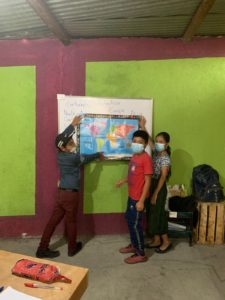
Teaching English in Santiago Guatemala